In a converted Victorian warehouse in Hackney, textile artist Sarah Chen holds up a jumper that's seen better days. What should be destined for the charity bag has instead become her canvas—a deliberate landscape of golden threads weaving through worn elbows, transforming damage into decoration. "I'm not hiding the holes," she explains, running her fingers along the visible mends. "I'm celebrating them."
 Photo: Sarah Chen, via lyricstranslate.com
Chen is part of a quiet revolution spreading across Britain's creative communities, one that borrows its philosophy from an ancient Italian practice called rammendo—the considered, artistic act of mending rather than discarding. Unlike quick fixes designed to disappear, rammendo treats repair as an opportunity for creative expression, turning necessity into beauty.
Beyond the Throwaway Mentality
The movement couldn't come at a better time. Britain generates over 300,000 tonnes of textile waste annually, much of it perfectly salvageable clothing dismissed for minor imperfections. But Italian rammendo offers a different narrative—one where visible mending becomes a badge of honour, a story worth telling rather than hiding.
"In rural Italy, my grandmother would spend winter evenings repairing the family's clothes," explains Marco Benedetti, a London-based fashion designer whose collections now feature deliberate repair aesthetics. "But it was never just about function. She'd use contrasting threads, decorative stitches—the mend became more beautiful than the original fabric."
This philosophy is resonating with British creatives who've grown weary of fast fashion's disposable culture. From repair cafés in Edinburgh to visible mending workshops in Birmingham, the movement is gaining momentum as both practical skill and philosophical stance.
The New Makers' Movement
In Manchester's Northern Quarter, The Mending Library has become an unlikely creative hub. Founded by textile artist Emma Rodgers, it offers workshops that blend traditional Italian techniques with contemporary British sensibilities. "People arrive thinking we'll teach them invisible repairs," Rodgers says. "They leave understanding that the most beautiful mending is meant to be seen."
 Photo: Emma Rodgers, via static.wixstatic.com
 Photo: The Mending Library, via images.squarespace-cdn.com
The workshops attract an eclectic mix—fashion students learning to incorporate repair into their design practice, professionals seeking mindful evening activities, and environmental activists drawn to the anti-consumption message. What unites them is a growing appreciation for the Italian concept of 'tempo lento'—slow time—that rammendo demands.
London furniture maker James Wright has applied these principles beyond textiles, developing a practice he calls "honest restoration." His pieces deliberately showcase repairs using contrasting woods and metals, creating furniture that tells stories rather than hiding them. "Each crack, each break becomes part of the object's biography," Wright explains. "Italian craftsmen understood this centuries ago."
The Psychology of Repair
The appeal goes deeper than aesthetics. Dr. Rebecca Matthews, a psychologist studying craft therapy at Leeds University, suggests that visible mending offers psychological benefits our throwaway culture lacks. "The act of repair requires patience, acceptance of imperfection, and creative problem-solving," she notes. "It's meditative in ways that buying replacements simply isn't."
This resonates with British creatives seeking antidotes to digital overwhelm. Illustrator Tom Harding describes his weekly mending sessions as "analog meditation." Working from his South London studio, he's developed a practice of repairing vintage band t-shirts using embroidery techniques learned from Italian craftswomen. "It's the opposite of Instagram culture," he says. "Slow, imperfect, real."
Practical Philosophy
The movement's growth reflects broader shifts in British creative culture—a move toward sustainability, craftsmanship, and intentional living. Repair cafés, once niche community initiatives, now operate in over 300 British locations, many incorporating Italian-inspired visible mending techniques.
Brighton-based workshop leader Anna Petrova has noticed the demographic evolution. "Initially, it was older people who remembered pre-throwaway culture," she observes. "Now it's young professionals, creatives, people who want their possessions to have meaning."
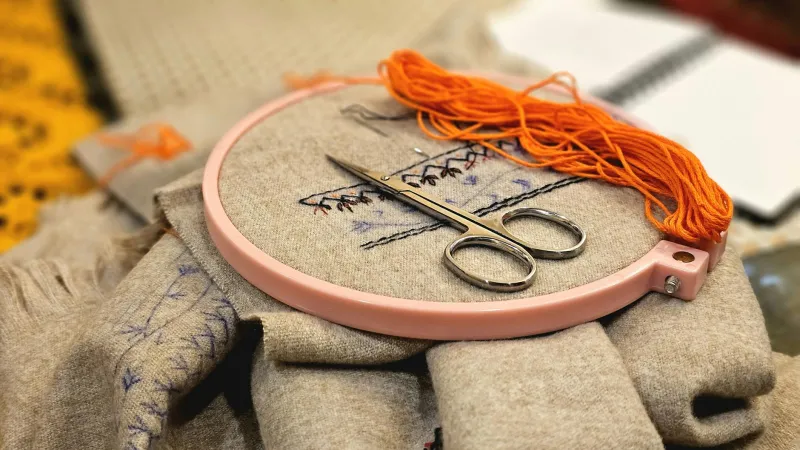
The technique itself is surprisingly accessible. Unlike invisible darning, which requires matching threads and perfect stitches, rammendo celebrates contrast and character. Bright threads on dark fabric, decorative patches over holes, embroidered reinforcements that become features rather than fixes.
The Creative Economy of Repair
Beyond personal practice, visible mending is entering Britain's professional creative landscape. Fashion brands like Patagonia have embraced repair aesthetics in their marketing, while independent designers build entire collections around reworked vintage pieces. The message is clear: repair isn't just sustainable, it's desirable.
This shift represents more than trend-following. It's a fundamental reconsideration of value—from newness to narrative, from perfection to personality. Italian rammendo offers British creatives a framework for this transition, providing both practical techniques and philosophical grounding.
As Chen puts it, examining her latest project—a vintage coat transformed through strategic visible mending: "We're not just repairing clothes. We're repairing our relationship with the things we own, the time we spend, the stories we tell." In a culture obsessed with the next new thing, perhaps the most radical act is making the old thing beautiful again.