When architect Lucy Morrison moved into her Victorian terrace in Bath, the smallest bedroom seemed destined for storage. Instead, she stripped it bare, painted the walls museum white, and installed a single antique drafting table. Nothing else. No bed, no storage, no distractions. Just space dedicated entirely to the act of drawing.
"People think I'm mad," Morrison laughs, gesturing around her 2.5-metre-square sanctuary. "But this room has revolutionised my practice. When I step through that door, my brain knows exactly what's expected."
Morrison has discovered what Italian artisans have known for centuries—the power of the stanza dedicata, a space assigned entirely to one creative discipline. In a country where spare rooms typically serve multiple functions, this Italian approach to spatial dedication feels almost radical.
The Psychology of Single Purpose
The concept runs counter to British pragmatism. Why dedicate precious square footage to one activity when it could serve many? But environmental psychologist Dr. Sarah Fleming argues that our brains crave this kind of clarity. "Spaces hold memories of activities," she explains from her London practice. "A room that's used for sleeping, working, and eating creates cognitive confusion. The brain never fully settles into any one mode."
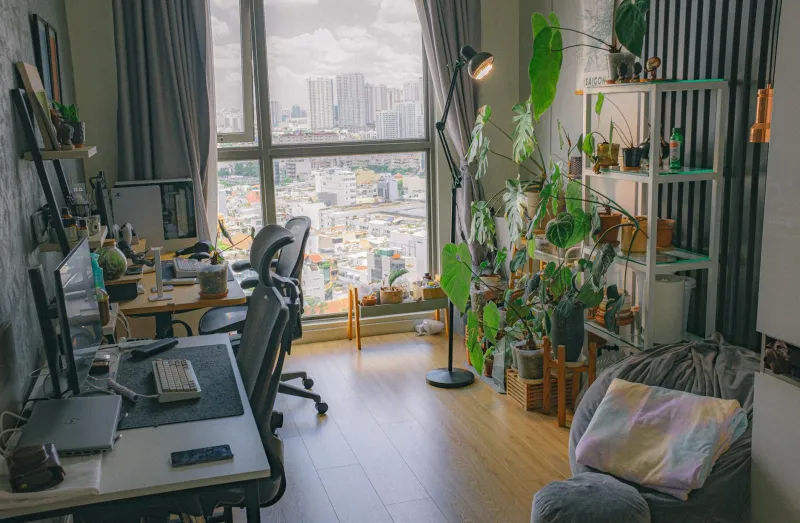
This resonates with photographer David Chen, who converted his Edinburgh flat's box room into what he calls his "editing cave." Measuring barely 1.8 by 2.4 metres, it contains only a monitor, chair, and carefully positioned lamp. "The moment I sit down here, I'm in editing mode," Chen explains. "There's no bed tempting me to nap, no bookshelf to distract me. Just the work."
Clever British Interpretations
British creatives are proving remarkably inventive in carving out dedicated spaces from modest homes. Textile artist Emma Walsh transformed her under-stairs cupboard into a weaving studio, complete with purpose-built shelving for yarns and a compact loom that folds against the wall. "It's tiny, but it's mine," she says. "When I crawl in there—literally—I'm in textile mode."
The key lies not in size but in intention. London writer James Hartley's "manuscript room" occupies half of his shared flat's living space, sectioned off by a elegant room divider. It contains only a typewriter, chair, and small shelf of reference books. "My flatmate thought I was being antisocial," Hartley admits. "But my writing productivity tripled when I stopped trying to work on the kitchen table."
Ritual and Routine
The Italian stanza dedicata isn't just about physical space—it's about ritual. Entering the room becomes a creative trigger, a psychological shift from everyday life to focused practice. Manchester illustrator Sophie Green has developed an elaborate entry ritual for her tiny painting room: lighting a specific candle, arranging brushes in precise order, playing the same Vivaldi piece. "It sounds precious, but it works," she insists. "By the time the music starts, I'm already thinking in colour."
This ritualistic approach echoes Italian bottega traditions, where apprentices learned not just technique but the importance of preparing space for serious work. "Italians understand that creativity requires ceremony," observes cultural historian Dr. Michael Rossi. "The space preparation becomes part of the creative process itself."
Making It Work in British Homes
Adapting the stanza dedicata to British housing requires creativity. Not everyone can spare an entire room, but the principle scales down beautifully. Graphic designer Tom Mitchell created his "thinking corner" using nothing more than a specific chair and side table positioned near his Brighton flat's window. "It's not a room, but it's dedicated space," he explains. "When I sit there with my sketchbook, that's all that happens there."
The key considerations are surprisingly simple:
Define the boundary clearly – whether it's a full room or just a corner, the space should feel distinctly separate from other activities.
Remove temptations – no phones, no unrelated books, no comfortable places to nap. The space should serve only its intended purpose.
Invest in good light – Italian studios prioritise natural light, but a quality desk lamp can transform even the darkest corner.
Create entry ritual – develop a consistent routine for beginning work in the space, whether it's lighting incense or arranging tools.
The Productivity Paradox
Counter-intuitively, dedicating space to single purposes often increases overall productivity. Ceramicist Rachel Davies noticed this when she stopped throwing pots at her kitchen table and converted her garden shed into a clay-only workspace. "I thought I'd use it less because it required more effort," she reflects. "Instead, I work more intensively. Every session feels significant."
This intensity reflects what Italians call 'concentrazione'—the ability to focus completely on the task at hand. When space serves multiple purposes, our attention fragments. When it serves one, focus deepens naturally.
Beyond the Creative
The principle extends beyond artistic practice. London consultant Maria Thompson created a "thinking room" containing only a comfortable chair and notebook stand. "I use it for strategic planning, difficult decisions, any thinking that requires depth," she explains. "It's transformed how I approach complex problems."
Similarly, yoga instructor Ben Clarke dedicated his spare room exclusively to practice, removing all furniture except a mat and small altar. "Students often ask about practicing at home," he notes. "I tell them: find one space, make it sacred, use it only for yoga. The space will teach you as much as any instructor."
The Italian Lesson
Perhaps the most profound aspect of the stanza dedicata is what it teaches about respect—for craft, for process, for the creative act itself. When we dedicate space to our practice, we're making a statement about its value. We're saying this work matters enough to claim territory, to establish boundaries, to create sanctuary.
As Morrison puts it, standing in her white drawing room: "Italians understand that creativity isn't a hobby you fit around life—it's a practice that deserves proper space. Once you experience that level of dedication, you can't go back to working on the kitchen table."