The Death of Magnolia
Walk through any British neighbourhood and you'll spot the signs: scaffolding against Victorian terraces, ladders leaning on converted warehouses, and the faint scent of lime mortar drifting through open windows. Something profound is happening to our walls, and it has everything to do with a 500-year-old Italian technique that's found new life in the hands of Britain's most daring creatives.
Sarah Chen, a former graphic designer from Birmingham, discovered fresco painting during a sabbatical in Tuscany three years ago. Today, she's booked solid until 2026, transforming everything from Shoreditch lofts to country house kitchens with pigment-rich murals that seem to breathe life into previously sterile spaces.
"The British obsession with neutral walls was killing our souls," Chen laughs, mixing ultramarine into wet lime plaster at her Digbeth studio. "We've spent decades terrified of colour, of permanence, of making bold statements in our own homes. Italian fresco culture taught me that walls aren't just boundaries—they're canvases for living."
Beyond the Instagram Moment
What separates this movement from the fleeting wall decal trends that dominated the 2010s is its deliberate embrace of permanence. Fresco painting—the technique of applying pigment to wet lime plaster—creates artwork that literally becomes part of the wall structure. It can't be peeled off, painted over without considerable effort, or swapped out when trends shift.
This permanence feels radical in 2025's throwaway culture, particularly for a generation raised on removable wallpaper and peel-and-stick everything. Manchester-based muralist James Wright, who spent two years apprenticing with master frescanti in Florence, sees this as precisely the point.
"We're so used to impermanence that committing to a wall feels like a revolutionary act," Wright explains while preparing cartoons for a commission in Altrincham. "My clients aren't just buying decoration—they're making a statement about staying put, about investing in their space, about believing in beauty that lasts."
The New Apprentices
The revival isn't happening in isolation. Across Britain, art schools are quietly introducing fresco workshops, while established painters are booking flights to Italy for intensive summer courses. The Royal College of Art recently partnered with the Istituto per l'Arte e il Restauro in Florence to offer the UK's first formal fresco diploma—applications outnumbered places by five to one.
Lucy Morrison, who teaches the programme, attributes the surge to a broader cultural hunger for authentic craft skills. "Our students are tired of digital everything," she notes. "They want to work with their hands, to understand materials, to create something that will outlast them. Fresco offers that connection to permanence and tradition that feels almost spiritual in our hyperconnected age."
The technical demands certainly separate casual participants from serious practitioners. True fresco requires understanding lime chemistry, pigment behaviour, and working within the narrow window when plaster reaches perfect dampness. There's no undoing mistakes—only adaptation and integration.
From Tuscan Hills to British Homes
But how does a technique perfected in Mediterranean light translate to Britain's famously grey skies? The answer lies in adaptation rather than imitation. Where Italian frescoes traditionally celebrate brilliant blues and warm ochres, British practitioners are developing a distinctly northern palette.
Cornish artist Emma Blackwood, whose botanical murals grace everything from London gastropubs to Yorkshire farmhouses, has spent three years perfecting what she calls "British earth tones"—colours drawn from local clay, slate, and sea glass rather than Italian hillsides.
"You can't simply transpose Tuscan techniques onto Manchester walls," Blackwood explains. "The light is different, the architecture is different, the cultural context is completely different. We're creating something new—a conversation between Italian tradition and British sensibility."
The Commissioning Renaissance
For homeowners intrigued by the movement, commissioning a fresco requires a different mindset than typical interior decorating. Prices start around £150 per square metre for simple designs, rising to £500-800 for complex narrative work. The investment reflects not just artistic skill but the irreversible nature of the medium.
Design consultant Patricia Hernandez, who specialises in matching clients with fresco artists, advises a thorough consultation process. "This isn't choosing between three paint colours," she warns. "We're talking about artwork that will outlive most furniture, possibly the homeowner themselves. It requires real commitment to the vision."
The most successful commissions emerge from genuine collaboration between artist and client, often involving months of discussion, sketching, and colour testing. Wright recalls one project where the client changed their mind six times before settling on a design—all before any plaster was mixed.
Living Heritage
What emerges from conversations with both artists and clients is a sense that this movement represents more than aesthetic choice. In an era of constant renovation and renewal, choosing fresco feels like an act of faith in the future, a belief that some things should endure.
Chen's latest commission—a sweeping landscape mural for a Manchester co-working space—will be unveiled next month. The design incorporates both Tuscan cypress trees and British oak, Italian light filtered through Manchester's industrial architecture. It's a perfect metaphor for the movement itself: ancient techniques finding new expression in contemporary British spaces.
"We're not trying to recreate the Sistine Chapel in Salford," Chen smiles. "We're creating something uniquely ours—Italian craft wisdom meeting British creative courage. These walls will be here long after we're gone, carrying our stories forward."
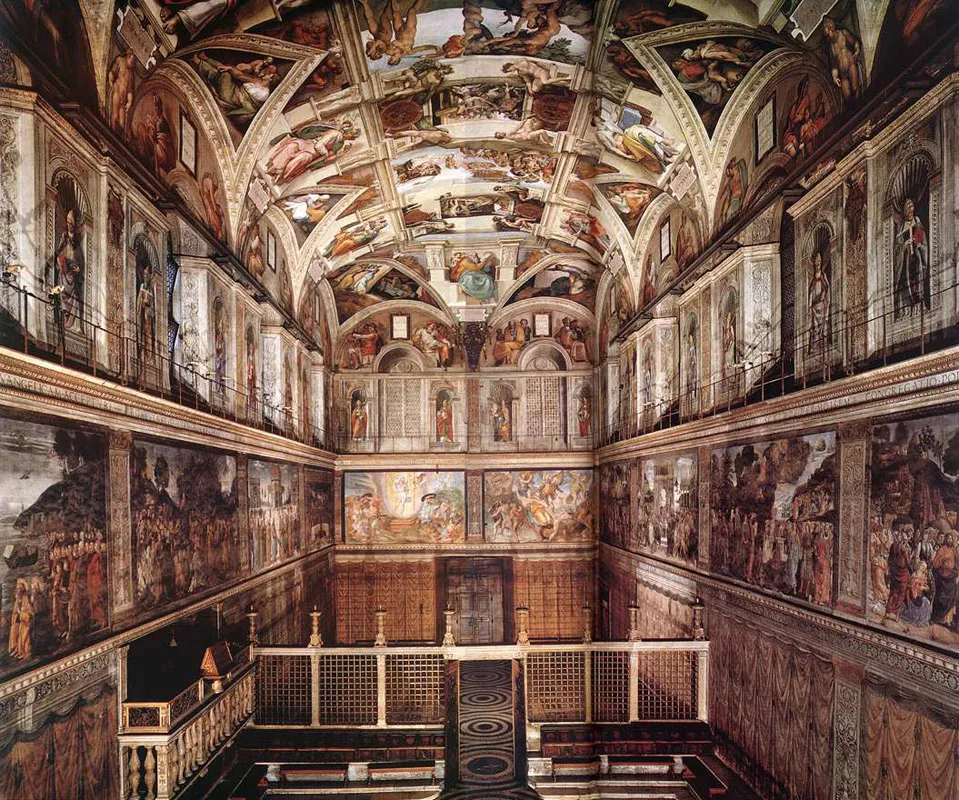 Photo: Sistine Chapel, via famouswonders.com
As Britain's creative rebels continue trading canvas for lime plaster, they're writing a new chapter in both Italian tradition and British design history—one permanent, pigment-rich wall at a time.