The Revolution Hiding in Plain Sight
Walk into most British home studios and you'll find the same scene: desks groaning under the weight of half-finished projects, walls plastered with inspiration boards that have become visual noise, and every surface claiming territory for yet another essential tool. It's creative maximalism at its most suffocating—and it's exactly what a growing movement of UK-based artists and designers are actively rejecting.
Enter dolce far niente, the Italian philosophy that translates literally as "the sweetness of doing nothing." But this isn't about Netflix binges or guilt-ridden afternoon naps. It's about something far more radical: the deliberate architecture of emptiness in spaces designed for creation.
Why Less Became the New More
Sarah Chen, a textile designer from Manchester, discovered this approach by accident during a residency in Tuscany. "I was working in this ancient villa where my studio was essentially four walls, one table, and a single window," she recalls. "I kept waiting for more equipment to arrive, more storage, more everything. But then I started creating the best work of my career."
Back in her Didsbury home, Chen has recreated that sense of intentional sparseness. Her desk—a reclaimed oak table from a Venetian workshop—holds only what she needs for her current project. Everything else lives in closed storage, out of sight and out of mind.
This isn't about minimalism for Instagram. It's about recognising that the British creative mind, conditioned by centuries of "make do and mend" mentality, has perhaps overcorrected into "keep everything and use it all at once."
The Science of Sacred Space
Neuroscientist Dr. Michael Thornton from UCL has been studying the relationship between physical environment and creative output. His research suggests that cluttered spaces don't just feel overwhelming—they actively compete for our attention at a neurological level.
"When every surface tells a different story, when every wall demands to be seen, the brain exhausts itself trying to process all the visual information," Thornton explains. "Italian domestic design has understood this for centuries. They create what I call 'cognitive rest stops'—areas where the eye and mind can simply pause."
Designing the Pause
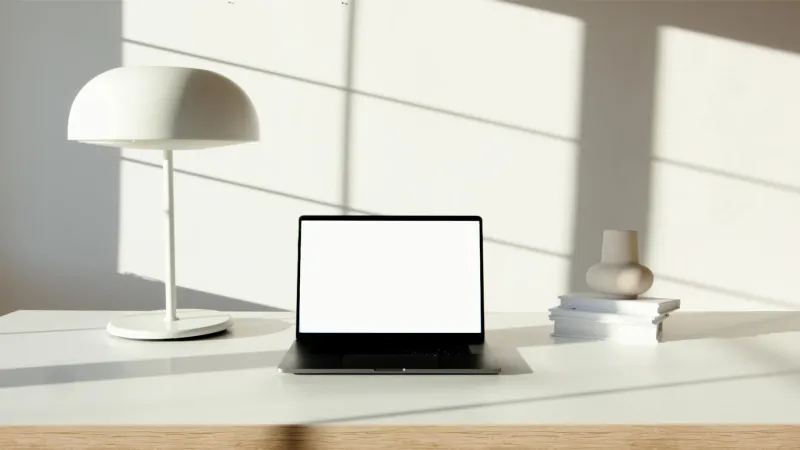
So what does a dolce far niente desk actually look like? It's not about stark emptiness—that's Scandinavian minimalism. Instead, it's about curated calm with distinctly Italian sensibilities.
Take the studio of London-based illustrator James Whitfield. His workspace centres around a single, substantial piece: an antique writing desk he found in a Florentine market. The surface remains deliberately clear except for three elements: his current sketchbook, a brass lamp that belonged to his Italian grandmother, and a small ceramic bowl for collecting the day's thoughts—literally. "I write down one word or phrase that captures what I want to explore, then I put it in the bowl," he explains. "Sometimes I fish them out weeks later. Sometimes I don't."
The walls around his desk are painted in what he calls "Tuscan nothing"—a warm, neutral tone that seems to absorb light rather than reflect it. One piece of art hangs above the desk: a simple charcoal sketch he made during his first trip to Rome. That's it.
The British Resistance to Rest
Of course, this approach runs counter to deeply embedded British attitudes about productivity and visible busyness. We've been conditioned to believe that a clean desk is the sign of an empty mind, that creativity requires chaos, that true artists work surrounded by the beautiful mess of their process.
"There's this Protestant work ethic thing where if you're not visibly struggling, you're not working hard enough," observes cultural historian Dr. Emma Hartwell from Oxford. "Italian culture has a different relationship with effort. They understand that sometimes the most productive thing you can do is create the conditions for inspiration to arrive."
The Furniture of Pause
The dolce far niente approach extends beyond desk surfaces to furniture choices that actively encourage rest. Birmingham-based furniture maker Tom Richardson has seen a surge in requests for what he calls "contemplation pieces"—chairs designed not for long work sessions but for the moments between work.
"People are asking for a chair they can turn away from their desk, something that faces the window or the garden," Richardson notes. "They want furniture that gives them permission to stop."
His most popular piece is inspired by the reading chairs found in Italian libraries: substantial enough to feel important, comfortable enough for extended sitting, but positioned to encourage looking outward rather than at a screen.
The Economics of Emptiness
There's also a practical element to this philosophy that appeals to British sensibilities. In a country where home studios are often carved out of spare bedrooms or kitchen corners, the discipline of dolce far niente forces creatives to be ruthless about what truly serves their work.
"I used to think I needed every art supply ever made within arm's reach," says Cardiff-based painter Rhiannon Davies. "Now I choose three colours and see what happens. It's not limitation—it's liberation from choice paralysis."
Creating Your Own Sacred Pause
The transformation doesn't require an Italian villa or a complete studio overhaul. It starts with one simple question: what would this space look like if it was designed for thinking rather than doing?
Begin with your desk surface. Clear everything except what you need for today's work. Notice how this feels. Then look at your walls—are they inspiring you or overwhelming you? The Italian approach suggests that inspiration comes not from constant visual stimulation but from the space between stimuli.
Finally, create what Italian designers call a "breathing corner"—a space in your studio that serves no productive purpose except to exist. A chair that faces away from your work. A small table that holds only a plant or a cup of tea. A reminder that creativity, like breath, needs both expansion and pause.
The Sweet Spot of Nothing
As Britain's creative industries continue to grapple with burnout and the pressure of constant productivity, perhaps the answer isn't found in doing more, but in deliberately doing less. The Italian gift of dolce far niente offers not just a design philosophy but a radical reimagining of what creative work can look like when it includes the revolutionary act of purposeful pause.
In a culture that mistakes busy for productive, creating space for nothing becomes the most productive thing of all.