Swimming in Ink: The Ancient Florentine Art Making Waves in Britain's Paper Renaissance
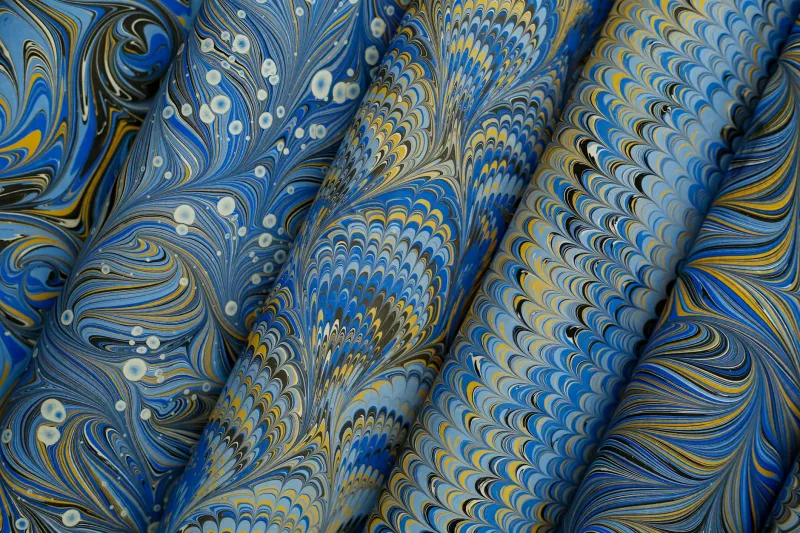
In a converted Victorian warehouse in Hackney, Sarah Mitchell dips her wooden comb through a bath of floating pigments, watching cobalt blues and burnt siennas spiral into patterns that would have made Renaissance bookbinders weep with envy. She's practising carta marmorizzata — the hypnotic art of paper marbling that once graced the endpapers of precious manuscripts in 16th-century Florence.
"There's something almost shamanic about it," Sarah explains, lifting a sheet of handmade paper from the gel bath to reveal swirls that seem to capture the very essence of water in motion. "You can plan and plot, but ultimately, you're collaborating with forces beyond your control."
The Quiet Revolution
Across Britain, a quiet revolution is taking place in studios, spare bedrooms, and converted outbuildings. Makers, publishers, and designers are rediscovering this most tactile of arts, drawn by its unhurried pace and unpredictable beauty. Unlike digital design, where Command+Z offers infinite do-overs, marbling demands presence, acceptance, and a willingness to embrace the unexpected.
The technique itself reads like medieval alchemy: carrageenan powder whisked into water creates a gel-like surface that holds floating pigments in suspension. Ox-gall — yes, literally bile from cattle — acts as a surfactant, allowing colours to spread and flow. Combs, rakes, and styluses become wands, manipulating the floating paint into patterns with names like "stone", "bouquet", and the coveted "peacock".
From Florence to Frome
In the Somerset town of Frome, bookbinder James Whitworth has transformed his garden shed into a marbling sanctuary. His journey began with a pilgrimage to Florence's Il Papiro workshop, where fourth-generation marbler Giuliano Giannini taught him the secrets passed down through centuries of Tuscan craftsmen.
"Giuliano showed me papers his great-grandfather had marbled in the 1920s," James recalls, his hands still stained with yesterday's ultramarine. "The patterns were as fresh as if they'd been made that morning. There's something about the Italian approach — this reverence for the material, for time, for the conversation between maker and medium."
James now supplies marbled papers to boutique publishers across the UK, his sheets finding their way into limited edition poetry collections and luxury journals. Each paper is unique, carrying within its swirls the particular conditions of the day it was made — the humidity, the temperature, even the mood of the maker.
The Sensory Sanctuary
What draws British makers to this quintessentially Italian craft isn't just its visual beauty, but its profound sensory richness. In our increasingly digital world, marbling offers something screens cannot: the smell of alum-treated paper, the weight of pigment-laden brushes, the satisfying resistance of a comb drawn through thickened water.
"It's meditation in motion," explains Lucy Chen, who runs weekend marbling workshops from her studio in Edinburgh. "My students arrive wired from their week, phones buzzing, minds racing. Within an hour, they're breathing differently. The craft demands it."
Lucy learned her technique through painstaking study of historical texts, including a 1662 manual by Athanasius Kircher that she tracked down in the British Library. "The Italians were obsessed with documenting their methods," she notes. "Every ratio, every gesture, every seasonal variation — it's all there if you know where to look."
Beyond the Book
While marbling's roots lie in bookbinding, British makers are pushing the craft into new territories. London-based stationery designer Emma Walsh uses marbled papers for wedding invitations, bringing Renaissance elegance to contemporary celebrations. Her "British Weather" series captures the moody skies of home through Italian techniques, creating papers that seem to hold Yorkshire storms within Tuscan traditions.
Meanwhile, in Glasgow, small press publisher Marcus Reid has made marbled endpapers his signature, commissioning unique patterns for each poetry collection he releases. "Every book becomes a collaboration," he explains. "The poet provides the words, I provide the structure, and the marbler provides the soul."
The Economics of Beauty
This revival isn't just artistic — it's economic. As consumers increasingly seek authentic, handmade alternatives to mass production, marbled papers command premium prices. A single sheet might sell for £20-50, while commissioned pieces for luxury brands can reach hundreds of pounds.
"There's a hunger for things that carry human touch," observes Sarah from her Hackney studio. "People are tired of perfection, of algorithms, of things that look like everything else. Marbling offers the opposite — irreproducible beauty born from controlled chaos."
The Future Flows Forward
As Britain's marbling community grows, connections with Italian masters remain strong. Annual pilgrimages to Florence continue, while Italian marblers increasingly visit UK workshops, sharing techniques refined over generations. It's a beautiful symbiosis — Italian wisdom taking root in British soil, growing into something entirely new yet respectfully rooted in tradition.
In her final demonstration of the day, Sarah creates a "feather" pattern, drawing her stylus through floating colours with movements as fluid as dance. The resulting paper captures something ineffable — not quite Italian, not quite British, but something altogether more beautiful: the meeting of two creative cultures in the swirling space between intention and surrender.
As she lifts the finished sheet to dry, droplets of coloured water catch the afternoon light, and for a moment, the centuries collapse. Here, in this converted warehouse in East London, the spirit of Renaissance Florence lives on, flowing forward into Britain's creative future, one impossible, irreplaceable sheet at a time.