Ledgers of the Imagination: What Renaissance Bankers Can Teach the Overwhelmed British Freelancer

There's a particular kind of Friday afternoon dread familiar to most British freelancers. Three client projects in various states of incompletion, a folder called 'FINAL_v3_ACTUAL_FINAL' sitting somewhere on a desktop, and a vague but persistent feeling that something important has been forgotten. It's the administrative fog that quietly swallows creative energy whole.
The solution, it turns out, may have been sitting in a Florentine archive for the past six hundred years.
The Merchant Mind Behind the Masterpiece
When we think of Renaissance Florence, we tend to picture Botticelli, Brunelleschi, the Medici in their finery. What we rarely picture is the extraordinary bureaucratic machinery humming beneath all that beauty. The great banking houses of the fourteenth and fifteenth centuries — the Bardi, the Peruzzi, the Medici themselves — were running commercial empires that stretched across Europe, and they needed systems to match.
What they developed was, in essence, the world's first creative productivity framework. Florentine merchants pioneered the double-entry bookkeeping system, yes, but they went considerably further. Their libri segreti — secret ledgers — tracked not just money but relationships, reputations, ongoing negotiations, and the status of long-running commissions. Entries were colour-coded by urgency. Accounts were cross-referenced using a web of marginal notations. Different categories of correspondence were filed in dedicated filze, bundles of documents tied with coloured cord that signalled their contents at a glance.
These weren't just financial tools. They were systems for managing complexity — for keeping a vast, living, interdependent network of projects and people from collapsing into confusion.
Sound familiar?
The Four Principles Worth Stealing
British creative professionals working today — illustrators juggling six clients, ceramicists managing commissions alongside wholesale accounts, brand designers spinning multiple studios — face a version of the same challenge the Florentine merchant faced. Lots of moving parts. Variable timescales. Relationships that need tending. Output that matters.
The merchant approach breaks down into four principles that translate surprisingly cleanly into modern practice.
Separate the ledgers. Florentine houses kept distinct books for distinct purposes — one for active accounts, one for correspondence, one for long-term contracts. The modern equivalent is ruthlessly separating your project management from your financial tracking from your ideas archive. Keeping them all in one sprawling document is the equivalent of writing your client invoices in the margins of your sketchbook. Functional, technically. Chaotic, definitely.
Cross-reference everything. The genius of the Florentine system was its web of references — a note in one ledger pointing to a related entry elsewhere. For creative professionals, this means building a habit of linking: your client brief to your mood board, your mood board to your invoice, your invoice to your project notes. The point isn't digital tidiness for its own sake. It's being able to reconstruct the thinking behind any piece of work, months or years later, without excavating your email archive.
Use colour with intention. Merchant colour-coding wasn't decorative — red entries signalled urgency, black indicated completed transactions, specific inks were reserved for specific categories. Many British creatives already have an intuitive version of this in their physical studios. The discipline is carrying it into digital spaces too. A consistent, personally meaningful colour system applied to your project folders, calendar blocks, or client tags takes about a week to build and saves hours every month.
Maintain a libro segreto**.** The private ledger wasn't about secrecy in a suspicious sense — it was about depth. It held the context, the nuance, the background that the public-facing accounts couldn't capture. For a creative professional, this translates to a private project journal: not a polished portfolio document but a running, honest record of decisions made, directions abandoned, and lessons learned. The kind of document you'd never show a client but couldn't work without.
Putting It Into Practice: A Bristol Designer's Approach
Sophie Marchetti-Clarke, a surface pattern designer based in Bristol, started applying what she calls her 'merchant method' after hitting a wall with conventional productivity apps.
'I'd tried everything,' she says. 'Every app, every system. They all felt like they were designed for project managers, not for someone whose work is half intuition and half deadline. I started reading about how the Medici actually ran their operations and something clicked. The idea that you could have rigour without rigidity — that the system should serve the work, not the other way around.'
Sophie now keeps three separate documents: an active project ledger with colour-coded status markers, a client relationship file where she notes preferences, past feedback, and communication style, and a private journal she updates at the end of each week. 'It sounds like a lot,' she admits, 'but each one takes minutes to maintain. And I haven't had a Friday afternoon panic in about eight months.'
The Italian Lesson About Time
There's one more thing worth noting about the Florentine merchant system, and it's perhaps the most counterintuitive insight of all. These men were extraordinarily busy — managing international trade routes, political relationships, family obligations, and the odd commission to a local painter named Leonardo. And yet their systems were never designed for speed. They were designed for accuracy over time.
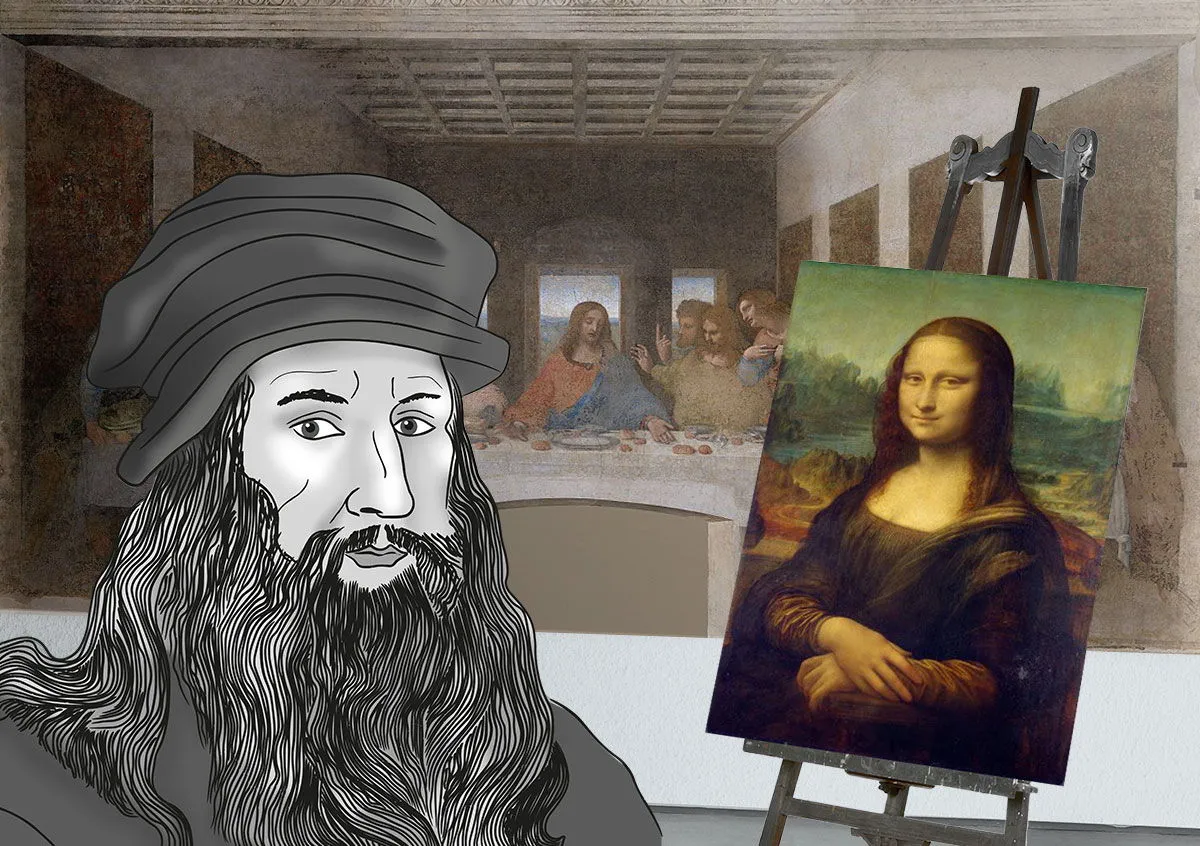 Photo: Leonardo, via www.theartstory.org
The ledger wasn't updated in frantic bursts. It was maintained in small, regular, deliberate increments. The Florentine merchant sat down each evening and made his entries. Not because he had to, but because he understood that the system only worked if it was tended consistently.
For the overwhelmed British freelancer, that might be the most radical idea of all. Not a productivity hack. Not a new app. Just the quiet, daily discipline of keeping the ledger current — and trusting that the clarity it creates will make everything else a little more possible.
Renaissance Florence built its cultural golden age on the back of extraordinarily good paperwork. There are worse places to take inspiration from.