Write in the Margins: How Renaissance Readers Turned Books Into Creative Laboratories
Photo: HonysTorresArt, CC BY-SA 4.0, via Wikimedia Commons
Somewhere in the Biblioteca Medicea Laurenziana in Florence, there are books that tell two stories simultaneously. The first is the one printed on the page. The second is written around it — in the margins, between the lines, and occasionally in increasingly urgent script climbing up the side of the page — by the humanist scholars who read these volumes in the 15th and 16th centuries. These marginal notes are not annotations in any dry, academic sense. They are arguments. Digressions. Sudden connections. Moments of pure, electric creative thinking captured in real time.
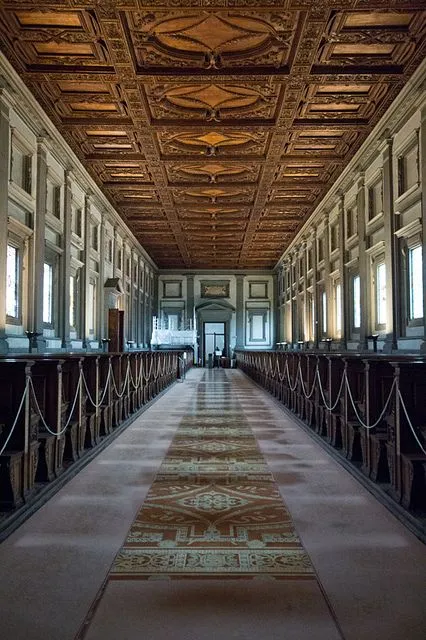 Photo: Biblioteca Medicea Laurenziana, via i.pinimg.com
They are also, as it happens, a model for one of the most productive reading habits you can develop as a working creative in Britain today.
The Humanist Reading Method
The Italian Renaissance humanists — Petrarch, Poliziano, Pico della Mirandola — approached books as sites of active intellectual encounter rather than passive consumption. Reading, for them, was inherently dialogic. You didn't simply receive a text; you responded to it, challenged it, let it collide with other ideas you were carrying, and recorded the sparks that resulted.
 Photo: Petrarch, via shakespeare-navigators.ewu.edu
This practice had a name — postillatura — and it was considered a mark of genuine scholarly engagement. A book returned unread was clean. A book returned read was marked, underlined, disputed, and enriched by the conversation that had happened between reader and page.
Critically, this wasn't about comprehension. The humanists weren't annotating to remember what the text said. They were annotating to discover what they thought — using the text as a kind of intellectual friction against which their own ideas could sharpen and take form. The margin was a second studio. The pencil was as important as the eye.
The Passive Consumption Problem
Contrast this with how most of us read now — or more accurately, consume. We scroll. We skim. We save articles to read later and never return to them. We listen to podcasts at 1.5x speed while doing something else entirely. Even when we do sit down with a physical book, we tend to approach it as an experience to be had rather than a conversation to be joined.
For British creatives working in design, illustration, writing, photography, architecture, or any of the dozens of disciplines that require genuine original thinking, this represents a quiet crisis. Not a dramatic one — nobody's collapsing at their desk from passive consumption overload — but a slow, cumulative erosion of a particular kind of cognitive muscle: the one that generates ideas through active engagement with other people's ideas.
We're reading more than ever and thinking less than we should. And the Renaissance scholars of Italy, of all people, saw this coming.
What Marginalia Actually Does to Your Brain
The research on this is increasingly clear. Active reading — the kind that involves physically responding to text, whether through annotation, underlining, question-writing, or simple disagreement in the margins — produces measurably different cognitive outcomes than passive reading. It deepens comprehension, yes, but more interestingly for creative practitioners, it dramatically increases the likelihood of associative thinking: the spontaneous connections between ideas from different domains that tend to be the actual origin point of original creative work.
The humanists understood this intuitively. Poliziano's marginalia are full of sudden lateral leaps — a passage from Virgil triggering a thought about contemporary Florentine politics, a note on Plato connecting unexpectedly to a problem in Latin grammar. These weren't distractions from the reading. They were the reading, at its most generative.
For a British graphic designer sitting with a book about architectural history, or a copywriter working through a collection of essays on Renaissance craft, or an artist reading about natural dye traditions — the margin is where the actual creative work happens. The text is the stimulus. The margin is the studio.
How to Start: A Practical Approach
The barrier to entry here is almost embarrassingly low, which might be why we tend to overlook this practice in favour of more elaborate productivity systems. You need a book. You need something to write with. You need permission — real, felt permission — to write in it.
That last one is the hardest for many British readers, who were raised to treat books as objects of reverence rather than tools of engagement. Get over it. A marked book is a used book, and a used book is a book that has done its job.
Start with questions, not summaries. The instinct when annotating is to underline and paraphrase — to record what the text says. Resist this. Instead, write questions in the margin. Why does this work? What would happen if this were reversed? Where have I seen this before? Questions generate thinking. Summaries just restate the obvious.
Let ideas from elsewhere in. When a passage triggers a thought from a completely different context — a project you're working on, a conversation you had last week, a problem that's been sitting unresolved at the back of your mind — write it down. Right there, in the margin. The cross-pollination of ideas across domains is the engine of creative originality, and the margin is where you can capture those moments before they dissolve.
Date your annotations. This is a small thing with significant payoff. When you return to a marked book months or years later, the dates tell a story — of where you were in your thinking, what you were preoccupied with, how your perspective has shifted. It transforms the book into a kind of creative journal, layered with time.
Disagree loudly. The humanists weren't shy about arguing with authors they admired. If something strikes you as wrong, or incomplete, or simply questionable, say so in the margin. Intellectual friction is productive. Polite, silent agreement is not.
The Slow Reading Movement in British Creative Circles
Among a particular strand of British creative practitioners — designers, independent publishers, makers, artists working outside the mainstream — there's a quiet but growing resistance to the velocity of contemporary information culture. Reading groups that meet monthly to work through a single demanding text. Workshops built around extended close reading and collective annotation. Independent bookshops in cities like Bristol, Edinburgh, and Manchester that have begun stocking vintage and second-hand volumes specifically because they arrive pre-annotated by previous readers, their margins already alive with other people's thinking.
This isn't nostalgia. It's a practical response to a real creative problem: how do you generate genuinely original ideas in an environment that rewards speed and punishes depth?
The Renaissance humanists, working in the cramped scriptoriums and sunlit loggias of 15th-century Florence, had an answer. Slow down. Pick up a pencil. Write in the margins.
The Most Radical Habit in Your Toolkit
In a creative landscape saturated with productivity apps, digital tools, and content streams that never stop, choosing to sit with a physical book and a pencil — to argue with it, question it, let it ignite unexpected thoughts — is genuinely countercultural. It's also, according to centuries of evidence and a growing body of modern research, genuinely effective.
The margin is not the edge of the page. For the Renaissance humanists, it was the centre of the creative act. It might just be the same for you.