The Villages That Tourism Forgot: Why British Potters Are Finding Their True Education in Italy's Hidden Ceramic Heartlands
The Villages That Tourism Forgot: Why British Potters Are Finding Their True Education in Italy's Hidden Ceramic Heartlands
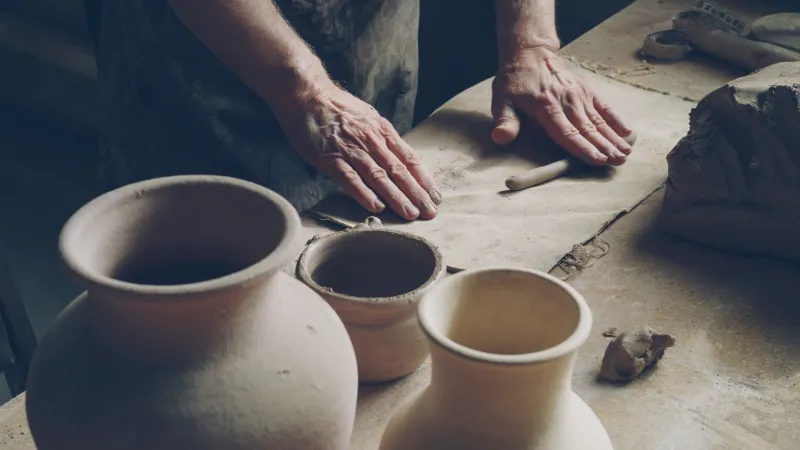
The road into Orvieto rises steeply from the valley floor, the town perched on its volcanic tufa rock like something dreamed rather than built. Most visitors come for the cathedral. A smaller number come for the wine. But for a certain type of British potter, the real draw is the clay — specifically, the particular red-brown earthenware that Umbrian craftspeople have been shaping and firing since before the Romans arrived, using methods that would be largely recognisable to those same ancient makers.
Orvieto is one stop on a loose itinerary that a growing number of British ceramicists are quietly piecing together — journeys that bypass the obvious cultural capitals in favour of villages and small towns where the pottery tradition isn't a heritage attraction but simply what people do. Deruta, yes — it's famous enough to appear in guidebooks — but also Grottaglie in Puglia, Assemini in Sardinia, and a scatter of Umbrian hill towns whose names don't appear on most tourist maps at all.
These aren't organised tours. They're pilgrimages, in the old sense: journeys made with intention, undertaken at some personal cost, and expected to change the traveller.
What the Famous Centres Can't Offer
There's nothing wrong with Deruta or Faenza — both are extraordinary places with deep, serious craft traditions. But their very fame has shaped them. Workshops there are accustomed to visitors, to explaining, to demonstrating. The interaction, however warm, has a performative quality. The craft is, to some extent, being shown rather than simply practised.
In the lesser-known centres, that dynamic shifts. Potters in Grottaglie — a Puglian town whose entire historic quarter, the quartiere delle ceramiche, is devoted to workshop after workshop — are generally too busy making things to explain themselves at length. You watch, you ask careful questions, you get short answers, and you learn through proximity rather than instruction.
Yorkshire-based ceramicist Fiona Aldred made her first trip to Puglia three years ago, initially intending to visit for two weeks. She stayed for two months. "In Grottaglie, the relationship between the maker and the material is completely unsentimental," she says. "There's no mystification of the process. Clay is clay, fire is fire, and the work gets done. I found that attitude — that directness — more instructive than any masterclass I'd ever attended."
She describes watching an elderly woman in a small workshop off the main square decorating plates with a speed and fluency that suggested complete unconscious mastery. "She'd been doing the same motif for sixty years. It wasn't repetition in any deadening sense — it was more like a musician who's played a piece so many times that they're finally free to be fully present in it. I went home and threw away half my tools. I wanted to know fewer things better."
The Philosophy in the Clay
What potters consistently report bringing back from these journeys isn't primarily technical knowledge, though they invariably pick up methods and approaches they hadn't encountered before. What shifts is something closer to a philosophy of making.
The traditions of Umbrian and Puglian earthenware are built around material honesty. The clay isn't disguised; the marks of the maker's hands aren't erased. Glazes tend to be simple — often just one or two colours, sometimes none at all. The aesthetic value of the work comes from the quality of the making, not from decorative complexity. This is, in some ways, the opposite of the direction much contemporary British studio pottery has taken, where surface treatment and conceptual framing often take precedence over fundamental craft.
Edinburgh potter James Raeburn, who spent six weeks in Sardinia studying the ancient brocche — the distinctive water vessels with their narrow necks and generous bellies — describes a reorientation that was almost uncomfortable. "Sardinian ceramic tradition is brutally functional. These forms evolved to do specific things — keep water cool, pour without dripping, stack efficiently. Every curve has a reason. Coming back to my studio, I looked at a lot of my work and realised I'd been making things that looked good on a shelf but didn't particularly do anything well. That bothered me."
He has since rebuilt his practice around what he calls 'earned beauty' — forms that justify their aesthetics through function. His work has become simpler, quieter, and considerably harder to make. It has also, he notes, started selling better.
The Slowness Is the Point
One of the consistent themes in accounts from potters who've made these journeys is the pace of village craft life — and how disorienting it initially feels to someone arriving from a British studio context shaped by social media, market deadlines, and the pressure to produce content as well as work.
In Assemini, on the outskirts of Cagliari, ceramic production follows rhythms determined by weather, season, and the firing schedules of shared kilns. Work is made in batches. Drying time is respected rather than hurried. The kiln is loaded when it's ready, not when a deadline demands it. This isn't quaint inefficiency — it's a workflow that produces work of remarkable consistency and quality because each stage is given the time it actually requires.
Leeds-based maker and teacher Amara Osei, who visited Umbria last spring, found the experience clarifying in ways she hadn't anticipated. "I'd been so focused on throughput — how many pieces per week, how to optimise my kiln loads — that I'd lost track of why I was making in the first place. Watching potters in a small village outside Perugia, I realised that the slowness wasn't an obstacle to good work. It was the condition for it."
She returned to Leeds and restructured her teaching accordingly, building longer pauses into her workshop schedules and explicitly framing the waiting — for clay to dry, for glazes to settle — as part of the creative process rather than dead time between the interesting bits.
Bringing It Home
The British potters who've made these journeys are careful not to romanticise what they've seen. Italian village craft culture has its own pressures and difficulties; the traditions they've encountered are in some cases genuinely endangered, with younger generations leaving for cities and workshops closing. The experience isn't a fantasy of a simpler life — it's an encounter with a different set of priorities and a different relationship between maker, material, and community.
But something real comes back with them. Fiona Aldred describes it as a recalibration of what matters. James Raeburn calls it permission — permission to care more about the quality of the making than the sophistication of the concept. Amara Osei simply says she returned knowing what kind of potter she wanted to be.
The clay in Puglia is different from the clay in Yorkshire. The light in Umbria is different from the light in Edinburgh. But the conversation between a maker and their material — that particular negotiation between intention and resistance, between what you want to make and what the clay will allow — turns out to be universal. And sometimes you have to travel a long way down an unmarked Italian road to remember that.