Hands Before Degrees: The British Studios Quietly Rebuilding the Renaissance Bottega from the Ground Up
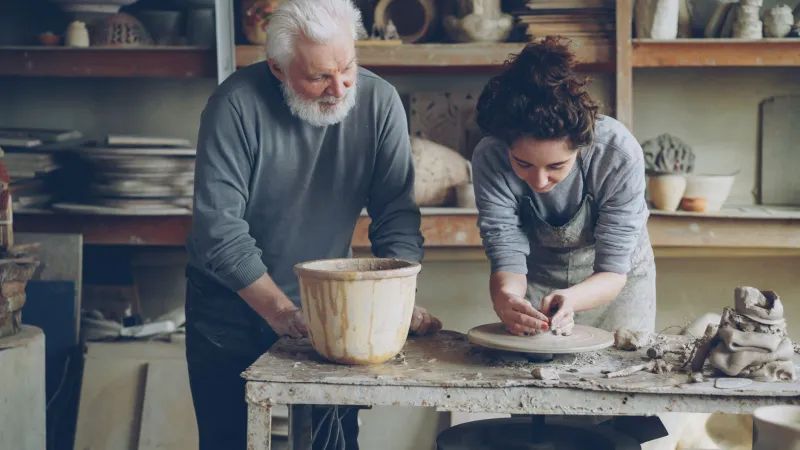
In 15th-century Florence, if you wanted to become a painter, you didn't apply to an institution. You found a master. You turned up at his workshop — his bottega — and you started at the bottom. You ground pigments. You prepared surfaces. You watched, listened, and waited. Years might pass before you touched a significant commission. But by the time you did, you understood the work from the inside out. You'd absorbed not just technique but temperament, not just skill but judgement.
It's a model that shaped Raphael, Botticelli, and Ghirlandaio. And right now, in studios scattered across the UK, a quiet but determined movement is asking whether it might shape the next generation of British creatives just as powerfully.
 Photo: Raphael, via www.boredart.com
The Problem with the Graduate Pipeline
Let's be honest about something the creative industry rarely says out loud: the graduate pipeline is increasingly producing technically capable but professionally unprepared young creatives. Not because universities are failing — many design programmes are genuinely excellent — but because the skills that make someone a truly effective studio practitioner are extraordinarily difficult to teach in a classroom.
Judgement under pressure. Client relationship instincts. The ability to revise work without losing confidence. Knowing when a concept is genuinely finished versus when you're just tired of it. These are things that develop through proximity to experienced practitioners, through watching decisions being made in real time, through making mistakes on live work and learning to recover from them.
Graduates often arrive in studios technically fluent but experientially thin. And studios, under commercial pressure, frequently don't have the bandwidth to provide the mentorship that would actually develop them. The result is a creative workforce that's broad but not deep — and a growing number of studio owners who are quietly asking whether there's a better way.
What the Bottega Actually Was
The Italian Renaissance workshop wasn't simply a place where a master employed assistants. It was a living educational ecosystem. A master craftsman — whether painter, sculptor, goldsmith, or architect — would take on apprentices as young as twelve or thirteen, who would live and work within the bottega for years at a stretch. The relationship was as much familial as professional.
Learning happened through observation, imitation, and gradual responsibility. An apprentice might spend months doing nothing but preparing canvases before being trusted to paint background foliage. Then drapery. Then secondary figures. Then, eventually, faces. Each stage was earned. Each stage built on the last. By the time a bottega-trained craftsman went out on his own, he didn't just know how to make things — he understood why they were made the way they were.
Crucially, the bottega also passed on something no curriculum can fully capture: the master's sensibility. His way of seeing, his standards, his professional ethics. This is why great workshops produced recognisable lineages — not just technical similarities, but philosophical ones.
The Studios Doing It Differently
In Leeds, a branding and identity studio has been running what its founder describes as a "slow hire" programme for the past four years. Rather than recruiting graduates into full roles, the studio takes on two people each year in a structured three-year arrangement that mirrors the bottega model closely. In the first year, they work across every function of the studio — client communications, project management, production, presentation. In the second year, they begin to specialise. By the third, they're leading projects under supervision.
"The difference between someone who's been through this and someone who came straight from a degree is night and day," the founder told us. "Not in raw talent — sometimes the graduates are more technically gifted. But in resilience, in professional instinct, in how they handle ambiguity. That stuff you can't teach in a lecture."
In Glasgow, a textile and surface design studio has taken a slightly different approach, partnering with a local college to offer a post-qualification placement that functions as a year-long immersion. Students come in after their degree, but the studio treats the placement as a genuine bottega relationship rather than work experience — assigning a senior designer as a dedicated mentor, giving the apprentice access to client conversations from the start, and building in formal reflection sessions every fortnight.
In both cases, the studios report lower staff turnover, stronger client relationships, and — perhaps most interestingly — a noticeable improvement in the quality of work produced by the apprentices compared to direct graduate hires at equivalent career stages.
What Apprentices Actually Say
The people going through these programmes are often surprisingly candid about what they weren't getting from formal education — and what the bottega model is giving them instead.
"At university, I learned to defend my work in crits," one current apprentice in the Leeds studio told us. "Here, I've learned to actually improve it. Those are completely different skills."
Another, working through the Glasgow textile programme, described the shift as going from performing creativity to practising it. "In education, everything is about the outcome — the portfolio piece, the final show. Here, it's about the process. You start to understand that the good work comes from the way you work, not from trying harder at the end."
This mirrors almost exactly what Renaissance sources tell us about the bottega experience. The master Cennino Cennini, writing in the late 14th century, was explicit that the development of an artist required not just instruction but habituation — the slow embedding of good practice into daily habit until it became instinct.
Making It Work in the Modern Studio
For UK studios considering this model, a few practical principles are worth bearing in mind.
Start with structure, not sentiment. The bottega worked because it had clear stages and clear expectations. Define what each phase of your apprenticeship looks like before you begin, and be honest with your apprentice about where they are in that journey.
Give access early. One of the most powerful aspects of the bottega was exposure to the full complexity of professional life from day one — not just the parts deemed appropriate for a junior. Let your apprentice sit in client meetings, hear difficult conversations, watch you make decisions under pressure.
Mentor deliberately. This isn't mentorship as an occasional coffee chat. It requires scheduled, structured reflection time. What did we do this week? Why did we make those choices? What would you do differently? This is where the real transmission happens.
Be patient with the timeline. The bottega operated on years, not months. If you're expecting transformation in a six-month placement, you're not running a bottega — you're running glorified work experience.
A Different Kind of Creative Future
The creative industry talks constantly about diversity, sustainability, and resilience. The bottega model quietly addresses all three — offering pathways into the profession that don't require the financial burden of a full degree, building studios with deeper institutional knowledge, and developing creatives who are genuinely equipped for the complexity of professional practice.
It won't replace formal education. It doesn't need to. But as a complement to it — or in some cases, as an alternative — it represents something that British studios are increasingly hungry for: a way of making creatives who don't just know things, but understand them.