The Maker's Uniform: Why British Artisans Are Rediscovering the Power of Purpose-Built Studio Dress
The Ritual of Transformation
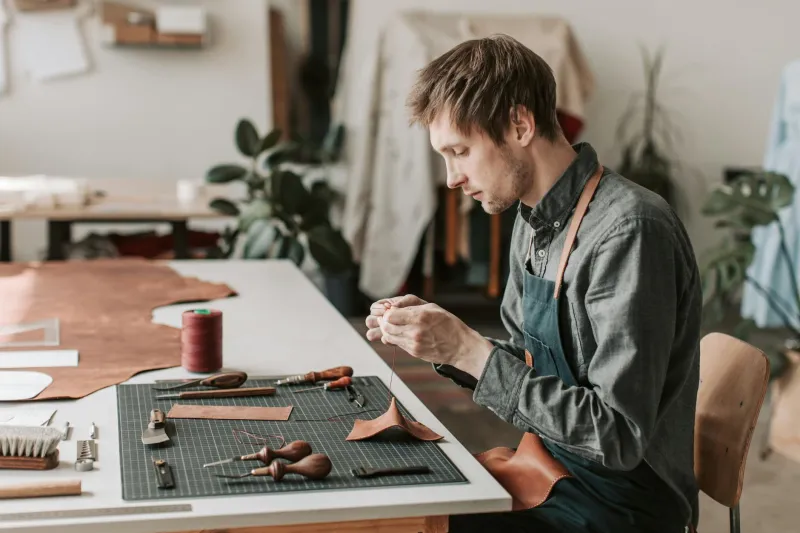
Every morning at precisely 9 AM, ceramicist Anna Blackwood performs the same ritual in her Derbyshire studio. She hangs up her everyday clothes, washes her hands with the same lavender soap, and carefully ties the strings of her hand-stitched leather apron—a piece commissioned from a local saddler, complete with custom pockets for her favourite tools and a brass nameplate bearing her workshop mark.
"People think I'm being precious," she laughs, smoothing the worn leather. "But this apron isn't just protection for my clothes. When I put it on, I become a different version of myself. I become the maker."
Blackwood is part of a growing movement of British artisans who are rediscovering the psychological power of purposeful dress—a tradition that stretches back through centuries of Italian botteghe, where the workshop apron was as much a symbol of professional identity as it was a practical necessity.
More Than Protection: The Italian Legacy
In Renaissance Italy, the artisan's apron was never merely functional. Walk through any period painting depicting a craftsman's workshop, and you'll notice the care with which these garments were rendered—the quality of the fabric, the precision of the construction, the pride with which they were worn. These weren't disposable work clothes, but carefully crafted tools of transformation.
The Italian tradition understood something that modern creative culture has largely forgotten: the clothes we wear to work don't just protect our bodies—they prepare our minds. The act of dressing for creative work signals to the brain that it's time to shift from everyday consciousness into the focused, purposeful state that real making requires.
"In Italy, there's never been a separation between craft and identity," explains Dr. Maria Benedetti, a cultural historian specialising in artisan traditions. "The apron, the smock, the specific tools—these weren't just equipment, they were extensions of the craftsperson's professional self. When you put them on, you weren't just protecting your clothes, you were stepping into your role as a maker."
The Psychology of Creative Dress
Modern psychology has a term for what Italian craftsmen understood intuitively: 'enclothed cognition'—the systematic influence that clothes have on the wearer's psychological processes. Studies have shown that what we wear doesn't just affect how others perceive us, but how we perceive ourselves and, crucially, how we perform.
When participants in psychological studies wore lab coats described as 'doctor's coats,' they showed increased attention to detail compared to those wearing identical coats described as 'painter's smocks.' The physical act of putting on specific garments literally changes how our brains function.
For creative professionals, this research validates what many are rediscovering through practice: the simple act of changing into work-specific clothing can serve as a powerful psychological trigger, marking the transition from everyday life into creative flow state.
The British Revival
Across Britain, this understanding is manifesting in a remarkable revival of bespoke work wear. In her textile studio in Glasgow, weaver Margaret Thomson commissioned a series of linen smocks from a local seamstress, each one designed for different stages of her creative process.
"I have one for planning and designing—it's lighter, with wider sleeves that don't catch on paper. Another for warping the loom—heavier fabric, closer fit. And a third for the actual weaving—that one has specific pockets for my shuttles and tools," she explains. "Each one puts me in a different headspace. When I put on my planning smock, my mind automatically starts thinking about patterns and possibilities."
This level of intentionality is becoming increasingly common among British makers. Bookbinder James Hartwell in Norwich works exclusively in a leather apron made by the same craftsman who supplies his binding tools. "It connects me to the tradition," he says. "Every morning when I tie those strings, I'm joining a conversation that goes back centuries."
Potter Sarah Mitchell in Cornwall has taken the concept even further, commissioning different aprons for different types of work—one for throwing, another for glazing, a third for firing days. "Each one has been designed specifically for its purpose," she explains. "But more than that, each one helps me think differently. My throwing apron makes me feel fluid and responsive. My glazing apron makes me feel precise and careful."
Beyond the Apron: A Complete Approach
The revival isn't limited to aprons. Across Britain's creative communities, makers are developing comprehensive approaches to studio dress that extend the Italian principle to every aspect of their work wear.
In her jewellery workshop in Bath, metalsmith Emma Carver has developed what she calls her 'making wardrobe'—a complete set of clothes designed specifically for different aspects of her craft. Her soldering outfit includes a high-necked shirt to protect from sparks, sleeves that can be precisely rolled to avoid catching in machinery, and trousers with reinforced knees for floor work.
"It's not about looking a certain way," she emphasises. "It's about feeling prepared. When I'm properly dressed for the work, I can focus entirely on the making without worrying about safety or comfort. The clothes become invisible, which is exactly what you want."
This comprehensive approach reflects a deeper understanding of how physical comfort and psychological readiness intertwine in creative work. When makers don't have to think about their clothing—when every element has been purposefully chosen and perfectly fitted—their attention can focus entirely on the work at hand.
The Commissioning Process
What's particularly striking about this revival is how many British makers are choosing to commission their work wear rather than buying off-the-shelf alternatives. This decision reflects both practical and philosophical considerations.
Practically, commissioned pieces can be tailored to the specific requirements of individual practices. A screen printer needs different pocket configurations than a ceramicist. A woodworker requires different fabric weights than a textile artist. Mass-produced work wear, no matter how well-designed, can't accommodate these specific needs.
Philosophically, commissioning work wear connects makers to the broader craft community. When bookbinder James Hartwell commissioned his leather apron, he was supporting another craftsperson while creating a piece that would, in turn, support his own creative practice. This interconnectedness reflects the Italian bottega tradition, where craftspeople supported each other's work across disciplines.
The Economics of Investment
While commissioned work wear requires a larger initial investment than shop-bought alternatives, many British makers find the economics surprisingly favourable. Well-made pieces last significantly longer than mass-produced alternatives, and their impact on creative productivity often justifies the cost.
"My first custom apron cost three times what I'd have paid for a standard one," admits ceramicist Anna Blackwood. "But that was five years ago, and it's still in perfect condition. More importantly, it's improved my work immeasurably. I'm more focused, more confident, more productive. How do you put a price on that?"
This long-term thinking reflects a broader shift in how British makers approach their tools and equipment. Rather than viewing work wear as a consumable expense, they're increasingly treating it as an investment in their creative practice—one that pays dividends in improved focus, enhanced professional identity, and deeper connection to craft traditions.
The Future of Maker Identity
As Britain's creative industries continue to evolve, the revival of purposeful work dress suggests a hunger for practices that ground creative work in physical reality. In an increasingly digital world, the simple act of putting on an apron or tying the strings of a smock becomes a powerful anchor to the tangible, the handmade, the real.
This revival also reflects a growing understanding of creativity as embodied practice. Just as Italian craftsmen understood that the mind and body work together in making, contemporary British artisans are rediscovering that how we dress for work affects not just how we look, but how we think, feel, and create.
In workshops from the Scottish Highlands to the Cornish coast, makers are putting on their aprons, rolling up their sleeves, and stepping into their creative identities with renewed intentionality. They're proving that in an age of fast fashion and disposable culture, the most radical act might be commissioning a single, perfect piece of clothing—and wearing it with pride, purpose, and profound respect for the transformative power of thoughtful dress.