Making by Season: The Ancient Italian Creative Calendar That's Saving British Studios from Burnout
The Year That Breathes
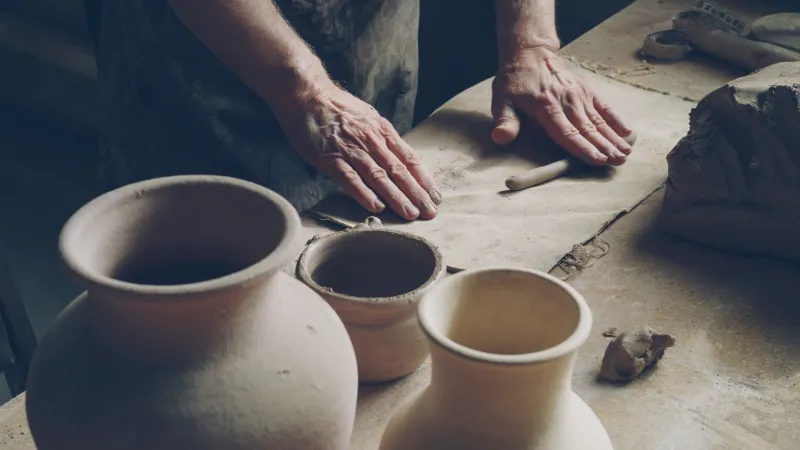
Somewhere in the Umbrian hills, there's an old ceramicist who still closes his workshop for six weeks every winter. Not because business is slow. Not because he's taking a holiday in any conventional sense. He closes because the clay rests, the glazes settle, and — crucially — so does his eye. When he reopens in February, he sees differently. He's not the same maker he was in November, and the work reflects that.
This isn't nostalgia or eccentricity. It's a working method that Italian craft traditions have maintained for centuries, rooted in a deeply practical understanding: creative work is cyclical, not linear. It has seasons. And ignoring those seasons doesn't make you more productive — it makes you less.
The UK's creative sector is currently navigating a burnout crisis that's difficult to overstate. Freelancers, studio owners, and in-house creatives across the country are reporting exhaustion, creative depletion, and a growing inability to distinguish between their best work and their merely adequate work. The always-on culture that digital tools have enabled — and that clients increasingly expect — is extracting a significant toll.
The Italian seasonal model offers something that feels almost counterintuitively simple: permission to stop.
What Seasonal Making Actually Means
It's worth being precise here, because 'seasonal working' can sound like a vague lifestyle aspiration rather than a practical framework. In the Italian craft and agricultural tradition, the seasons of making were specific and purposeful:
Winter was the time of consolidation and reflection. Tools were mended, accounts were settled, plans were laid. Production slowed or stopped entirely. This wasn't laziness — it was the necessary fallow period that made the rest of the year possible.
Spring brought collaboration and renewal. Workshops opened, apprentices returned, new commissions were taken on with the energy of fresh starts. It was an inherently social season — ideas were shared, partnerships formed.
Summer was for experimentation and risk. The long days and established rhythms of production created space for trying things that might not work — the kind of exploratory making that doesn't fit neatly into client briefs.
Autumn was harvest: the focused, skilled execution of the year's best ideas, produced with the confidence that comes from months of preparation and play.
This isn't a rigid prescription. But as a structural metaphor for a creative year, it's remarkably coherent — and increasingly being tested in British studios.
Studios Restructuring Around the Seasons
Clara and Rhys Pemberton run a small textile and product design studio from their home in rural Wales. Three years ago, they were working a recognisable pattern: constant availability, perpetual deadlines, a vague sense that their best ideas were being crowded out by the relentlessness of their schedule.
They'd read about traditional Italian craft calendars almost by accident — a footnote in a book about Florentine guilds — and decided to experiment with restructuring their year deliberately.
"We took January off. Properly off. No client work, no social media, no proposals," Clara explains. "We used the time to go back through the year's work and ask what we'd actually enjoyed, what had excited us, what we'd rushed past because there wasn't time."
What they found surprised them. Several of their most interesting experiments from the previous year had been abandoned mid-process because a client deadline intervened. The winter pause gave them space to return to those experiments — and two of them became the foundation for their spring collection.
"The fallow period wasn't empty. It was full of things we hadn't had time to notice," Rhys says.
The Productivity Paradox
Here's the thing that makes the seasonal model difficult to sell to a culture obsessed with output metrics: it looks, on the surface, like doing less. And in a purely quantitative sense, it is. Fewer hours billed in January. Fewer pieces completed in the quiet months.
But British studios experimenting with seasonal rhythms are reporting something that complicates the simple productivity calculus: the quality and distinctiveness of their work improves significantly, and the work they do produce in their 'active' seasons commands better attention and better fees.
This mirrors what Italian craft traditions always understood: that the rest period isn't separate from the productive period. It's part of it. The winter is when the summer's work is actually made, in the sense that it's when the thinking, the recovering, and the seeing-freshly happens.
Freelance illustrator Naomi Achebe, based in Nottingham, restructured her working year around what she calls 'creative seasons' after a period of serious burnout in 2022. "I used to feel guilty about not working. Now I understand that certain kinds of not-working are the work. The winter is when I become someone capable of making something worth making in the spring."
The Collaborative Spring
One of the more unexpected outcomes reported by British creatives adopting seasonal rhythms is how it transforms their relationship with collaboration.
When every season is equally pressured, collaboration becomes logistically difficult and emotionally draining. But when there's a shared understanding of which times of year are for opening up and which are for consolidating, collaborative work starts to happen more naturally.
Several studio owners describe the spring period of their restructured year as becoming organically more social — more visits, more joint projects, more cross-disciplinary conversations. This maps closely to the Italian workshop tradition of spring as the season of partnership and apprenticeship, when the renewal of energy made collective making feel possible and pleasurable.
Starting Your Own Creative Calendar
Adopting a seasonal framework doesn't require a complete restructuring of your business overnight. A few gentler starting points:
Map last year honestly. Look at when you did your best work, when you were most depleted, when you had your strongest ideas. You may already have natural seasons — you just haven't named or protected them.
Designate a quiet period. Even four weeks of genuinely reduced output in January or February can begin to shift the pattern. Use it for reflection, for reading, for the experiments you've been deferring.
Plan your spring deliberately. Rather than letting work accumulate chaotically, treat the post-quiet period as a genuine reopening. What do you want this season to be about?
Communicate the rhythm to clients. This is the part that feels risky but often isn't. Many clients, when told that a studio works in deliberate cycles, respond with interest rather than alarm. The ones who don't are usually the ones making you most exhausted anyway.
The Italian ceramicist in Umbria closes his workshop every winter not because he's stepping away from his practice. He's deepening it. The seasons aren't an interruption to the work. They are the work — just the part that happens in the dark, quietly, before anything is made.