Speaking Without Words: How Italy's Ancient Hand Language Is Revolutionising British Creative Presentations
The Unspoken Language of Ideas
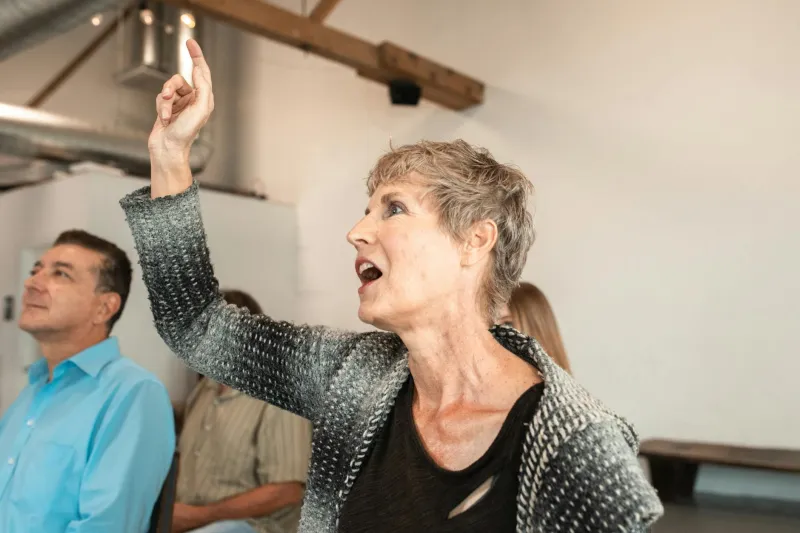
Watch any Italian architect explaining a building concept and you'll witness something remarkable: their hands sketch invisible structures in the air, fingers trace imaginary lines, and palms shape spaces that don't yet exist. This isn't mere animation — it's a precise, inherited vocabulary that communicates complex ideas faster than any slide deck.
Now, British creatives are discovering what Italians have known for centuries: that gesture isn't decoration for speech, but a language unto itself.
"I used to hide behind my laptop during presentations," admits Birmingham product designer Lucy Hartwell, demonstrating a fluid hand movement that somehow perfectly captures the concept of 'user flow'. "Learning to use my hands changed everything. Clients actually lean forward now."
The Science Behind the Gesture
Italian gesticulation isn't random flourishing — it's a sophisticated communication system with regional dialects, grammatical rules, and cultural nuances. Linguists have identified over 250 distinct hand gestures in the Italian repertoire, each carrying specific meaning that transcends language barriers.
For British creatives, this presents an untapped opportunity. While we excel at verbal precision and written clarity, our presentation culture often relies heavily on visual aids and scripted delivery. Italian gesture vocabulary offers a third dimension: spatial storytelling that engages audiences viscerally.
Dr. Elena Rossi, who studies gesture linguistics at Cambridge, explains: "Italian hand movements activate different neural pathways than speech alone. They create what we call 'embodied understanding' — the audience doesn't just hear your idea, they feel it spatially."
From Naples to Newcastle: Practical Translation
The key lies not in mimicking Italian gestures wholesale — that way lies caricature — but in understanding the principles behind them and adapting them to British creative contexts.
Precision over Performance
Italian gestures are economical. A slight pinching motion can convey 'exactly' more efficiently than saying the word. Manchester graphic designer Tom Walsh discovered this during client presentations: "Instead of saying 'we need to fine-tune this element,' I show them." His thumb and forefinger come together in a precise adjustment gesture. "Clients immediately understand the scale of change I'm suggesting."
Space as Canvas
Italian speakers use the space around them as a three-dimensional canvas. This translates beautifully to design presentations where concepts often exist in multiple dimensions. Edinburgh architect Sarah McKenzie now 'builds' her proposals in the air during client meetings, using her hands to show how spaces connect, how light moves, how people will navigate.
"I was explaining a renovation project last week," Sarah demonstrates, her hands creating invisible walls and openings. "Instead of flipping through floor plans, I showed them the journey through the space. They got it immediately."
The Workshop Revolution
Perhaps nowhere is gestural communication more transformative than in creative workshops and collaborative sessions. Traditional British workshop culture often relies on flipchart paper and sticky notes — valuable tools, but limited in their ability to convey dynamic concepts.
London design thinking facilitator Marcus Chen has revolutionised his sessions by incorporating Italian-inspired gesture vocabulary. "We developed a visual shorthand for common workshop concepts," he explains, demonstrating: hands expanding outward for 'divergent thinking', fingers coming together for 'convergence', a rolling motion for 'iteration'.
"Participants started using the gestures themselves," Marcus notes. "Suddenly, people who struggled to articulate abstract concepts were communicating fluently. The room energy completely changed."
Beyond the Boardroom: Studio Communication
The most profound impact of gestural communication happens in everyday studio interactions. Italian workshops have always operated with a rich vocabulary of spatial gestures — movements that convey texture, scale, proportion, and process without interrupting the flow of making.
Ceramicist Anna Petrov, who trained in Faenza before establishing her London studio, brings this tradition to her British practice. "When I'm teaching throwing techniques, words can be clumsy," she explains, her hands moving in smooth, circular motions that somehow capture the essence of centering clay. "These movements teach the body directly."
Her students, initially self-conscious about the gestural elements, soon embrace them. "It's like learning a secret language," says workshop participant David Kim. "Once you understand the gesture for 'even thickness' or 'controlled pressure', you can see it in other people's work instantly."
The Confidence Factor
Perhaps the most unexpected benefit of adopting gestural communication is its impact on creative confidence. British culture often emphasises verbal articulation and written communication, leaving many visual thinkers feeling inadequate in presentation settings.
Gestural vocabulary offers an alternative pathway to authority and clarity. "I used to dread client presentations because I'm not naturally eloquent," admits Bristol illustrator Jenny Walsh. "But when I learned to show my ideas spatially, everything shifted. I realised I'd been trying to translate visual concepts into words when I could communicate them directly."
The Cultural Translation
Adopting Italian gestural principles doesn't mean abandoning British communication values. Rather, it's about expanding our expressive repertoire while maintaining cultural authenticity.
The key is subtlety and intention. Where Italian gesture can be expansive and theatrical, British adaptation tends towards precision and understatement. A slight hand movement that clarifies a spatial relationship, a gesture that emphasises a key point, movements that support rather than dominate verbal communication.
Building Your Gestural Vocabulary
Start with Spatial Concepts
Begin with gestures that clarify spatial relationships: size, proximity, flow, connection. These translate naturally across cultural contexts and enhance rather than replace verbal communication.
Practice in Low-Stakes Settings
Develop your gestural vocabulary during casual studio conversations or informal team meetings before incorporating it into client presentations.
Observe and Adapt
Watch how Italian designers and architects use gesture in interviews and presentations. Notice the economy of movement, the precision of spatial description, the way gesture supports rather than competes with speech.
Develop Studio-Specific Gestures
Create a shared gestural vocabulary with your team or collaborators. This becomes particularly powerful in workshop settings where quick, clear communication enhances creative flow.
The Future of Creative Communication
As British creative practice becomes increasingly collaborative and international, the ability to communicate across language and cultural barriers becomes invaluable. Gestural vocabulary offers a universal language that transcends verbal limitations.
More importantly, it reconnects us with the physical, spatial nature of creative thinking. In a digital-first world, rediscovering the power of embodied communication feels both revolutionary and deeply natural.
The Italians have always known that great ideas live in the space between words, in the gesture that captures what language cannot quite express. For British creatives willing to expand their expressive vocabulary, that space holds remarkable possibilities.