Rules of Red: How Ancient Venetian Colour Laws Are Unleashing Creativity in Britain's Boldest Design Studios

Rules of Red: How Ancient Venetian Colour Laws Are Unleashing Creativity in Britain's Boldest Design Studios
When Venetian authorities banned the use of crimson lake and ultramarine blue for all but the most sacred commissions in 1472, they probably didn't expect to revolutionise artistic innovation. Yet their sumptuary laws — designed to prevent colour-based displays of wealth — accidentally created the conditions for some of history's most ingenious creative solutions. Five centuries later, this lesson isn't lost on a new generation of British design studios who are deliberately constraining their colour palettes to achieve extraordinary results.
The Original Colour Wars
Venice's relationship with colour was always political. As Europe's gateway to Eastern spice routes, the city controlled access to the most coveted pigments: the deep blues extracted from lapis lazuli, the brilliant reds derived from cochineal insects, and the luminous golds that required actual precious metal. These colours weren't just beautiful — they were statements of power, wealth, and social position.
The sumptuary laws that emerged weren't arbitrary restrictions but carefully calculated social engineering. By limiting who could wear or display certain colours, Venice maintained a visual hierarchy that reinforced political stability. Merchants might accumulate wealth, but they couldn't dress like nobles. Artisans could create beauty, but within prescribed boundaries.
What the lawmakers didn't anticipate was how these constraints would force artists and craftspeople to become alchemists of creativity. Forbidden from using pure ultramarine, painters learned to mix complex alternatives that often proved more subtle and sophisticated than the originals. Textile workers denied access to imperial purple developed intricate patterns and textures that made simpler colours sing with unprecedented vibrancy.
The Modern Constraint Revolution
This historical lesson is driving an unexpected movement across Britain's design landscape. Studios from Manchester to Edinburgh are voluntarily imposing colour restrictions on their work — not to save money or follow trends, but to push their creative thinking into uncharted territory.
Brand design studio Monochrome & Co. in Bristol has built its entire practice around single-colour challenges. For each client brief, they randomly select one Pantone colour and must create all visual identity elements using only that hue plus black and white. What sounds like creative suicide has instead produced some of the most memorable branding work emerging from the UK's independent design scene.
"The constraint forces us to think about hierarchy, texture, and form in completely different ways," explains creative director Priya Sharma. "When you can't rely on colour contrast to guide the eye, every other design element has to work harder. The results are often more sophisticated than anything we'd create with unlimited options."
The Psychology of Creative Limitation
Research in cognitive psychology supports what Venetian artisans discovered through necessity: constraints can enhance rather than diminish creative output. The phenomenon, known as the "creativity constraint paradox," occurs when limitations force our brains to explore unusual solution pathways that remain hidden when all options appear available.
Dr. Sarah Chen, a creativity researcher at Imperial College London, explains: "When faced with infinite choices, we tend to default to familiar patterns. Constraints break those patterns by making obvious solutions impossible. The brain then engages in more exploratory, innovative thinking to work within the imposed boundaries."
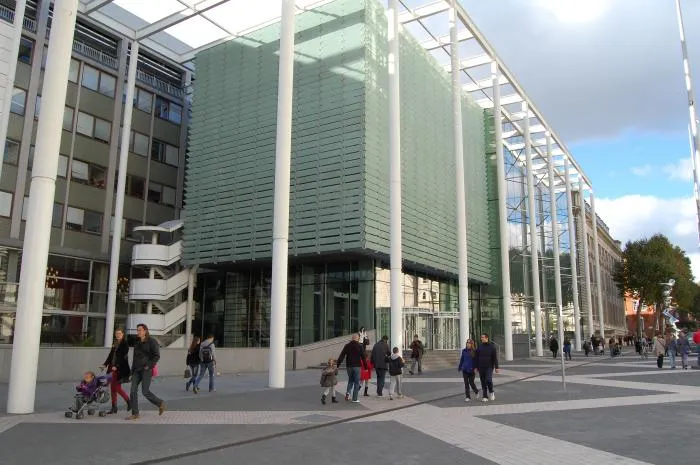 Photo: Imperial College London, via photos.wikimapia.org
This principle extends beyond colour to encompass any design constraint. Typography studios are limiting themselves to single font families. Web designers are embracing brutally minimal CSS. Product designers are working exclusively with materials sourced within fifty miles of their studios.
Practical Constraint Strategies
The most successful constraint-based approaches share certain characteristics. They're specific enough to eliminate obvious choices but flexible enough to allow genuine exploration. London-based packaging design studio Finite Elements has developed what they call "constraint roulette" — a system where different team members suggest limitations that are then randomly assigned to new projects.
Recent challenges have included designing luxury perfume packaging using only recycled cardboard, creating a tech startup's visual identity with colours found exclusively in British birds, and developing restaurant branding using only typographic elements that could be carved from wood.
"The randomness is crucial," notes studio founder Marcus Webb. "If we chose our own constraints, we'd unconsciously select limitations we already know how to navigate. The unexpected combinations force genuine innovation."
The Client Conversion
Selling constraint-based thinking to clients requires careful positioning. Rather than presenting limitations as restrictions, forward-thinking studios frame them as precision tools for achieving distinctiveness in oversaturated markets.
Glasgow-based digital agency Narrow Focus has perfected this approach, beginning client presentations with examples of how constraints have historically driven innovation — from haiku poetry to iPhone design. They then propose custom limitations based on each client's specific differentiation challenges.
"Most brands fail because they try to appeal to everyone," observes agency director Claire Morrison. "Constraints help us identify what makes each client unique, then amplify those qualities through focused creative decisions."
The approach has proven particularly effective with startups and scale-ups who need to establish strong brand recognition quickly. By embracing deliberate limitations early, these companies develop visual languages that are inherently distinctive and memorable.
Beyond Colour: Expanding the Philosophy
While colour restrictions offer the most direct parallel to Venetian sumptuary laws, British studios are applying constraint thinking across all design disciplines. Architecture firms are limiting material palettes to three elements per project. Fashion designers are creating entire collections using only deadstock fabrics. Graphic designers are working exclusively with found typography from specific historical periods.
The key insight driving these experiments is that constraints don't limit creativity — they redirect it. By removing certain possibilities, designers are forced to explore territories they might never have discovered through conventional approaches.
The Constraint Community
What started as isolated studio experiments is evolving into a loose community of practice. Monthly meetups in major British cities bring together designers working under various self-imposed limitations. These gatherings serve both as showcases for constraint-driven work and workshops for developing new limitation strategies.
The community has also spawned online resources, including constraint generators, challenge databases, and forums for sharing breakthrough techniques discovered through limitation-based work. Unlike typical design communities focused on inspiration and trends, this network emphasises process innovation and systematic creativity development.
Looking Forward: The New Renaissance Rules
As this movement matures, patterns are emerging that echo the sophisticated colour politics of Renaissance Venice. The most successful constraint-based studios aren't randomly limiting themselves but developing systematic approaches to creative limitation that can be applied across different project types and client needs.
Some are creating "constraint libraries" — collections of tested limitations that reliably produce innovative results. Others are developing constraint hierarchies, where basic limitations are layered with additional restrictions as projects progress.
The ultimate goal isn't to make design more difficult but to make it more intentional. By consciously choosing what not to do, these studios are discovering new possibilities for what they can achieve. In an industry often criticised for homogeneous outcomes and trend-following, constraint-based thinking offers a path toward genuine differentiation.
As Venice's ancient lawmakers inadvertently proved, the most powerful creative tool might not be unlimited freedom but the wisdom to know which freedoms to surrender.